How Zee Makes Whip Crackers
How do I make my own whip crackers?
Aside from basic throwing tips, this is my most common question. So I decided to collect my thoughts here in a few sections.
Basics
A cracker is the part of your whip whoever is on the other side is going to feel. It’s the part that will break the sound barrier when it cracks. Your cracker will define how your whip cracks, how it feels, and it’s material, measurements, and more will all impact how you use your whip. The best part of making your own crackers is you can find what makes you happy and really customize what works for you.
A cracker is essentially made by taking a piece of string of some material, pulling it straight, twisting it, folding it in half, and then letting the string twist on itself. Then tying a knot to keep it twisted.
A cracker has 3 parts
- The twisted end that may serve as a loop to attach your cracker to things
- The Knot
- The fluff
Color
Color matters a lot, it’s amazing to me how many whips come with a black cracker, or worse are traditional signal whips with black crackers permanently plaited in. When I started buying crackers, I was getting UV reactive ones from PennyEmporium. If you know me you know I love neon, and glowing. Specifically I love neon pink the most. So I leaned heavily into neon pink crackers. They work great in the daylight, and in neutral white/warm white light. But in the dungeon, with party lights, pink gets hard to see, even when it’s glowing under a blacklight.
I was at Thornwood this year, playing at night on the blacktop, and the person I was whipping was backlit. Backlighting is always a nightmare because you’re almost always going to be catching the light shining into your eyes a bit, but that light was pink/red/purple. And I couldn’t see my cracker to save my life. All I had on me was pink. The same thing would happen several more times through the weekend inside and out, and I’ve sworn off pink for the interim.
So now I’ve switched to only neon green and white. Not my color palette exactly, but I can see it most of the time.
Cracker Material:
While I’ve bought crackers from PennyEmporium of various materials, I primarily stick to two materials for my own making:
18 Mason Line
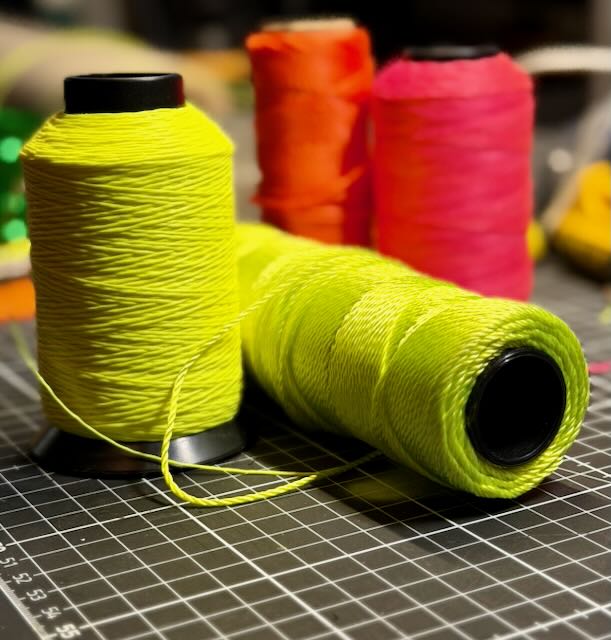
Mason Line is a nylon twine used often in masonry and construction to help create long, level lines, grids for pavers, and more. It’s somewhat strong, very soft, and really easy to work with. As a bonus it also comes in a ton of colors that are highly visible. I usually find it at my local hardware store.
I find the crackers are super easy to twist but the knots are a bit tricky, I’m sure I could peel the strands out to make a smaller knot but that’s hard for me.
I usually end up with a single line twisted once for my cracker. I start with a piece of line roughly 90cm long and twist using the method below.
B55 Dacron Bow String
Dacron, Dynamo, Kevlar and other Ultra-High-Molecular-Weight Polyethylene (UHMWPE) strings are incredibly strong materials used for many purposes, but as the name suggests, I’m buying B55 Bow String. Specifically I buy BCY B55 from 60xCustom strings. This is the only brand I’ve found that seems to offer super fun colors as well as a quality product.
The material, compared to mason line, is incredibly thin.
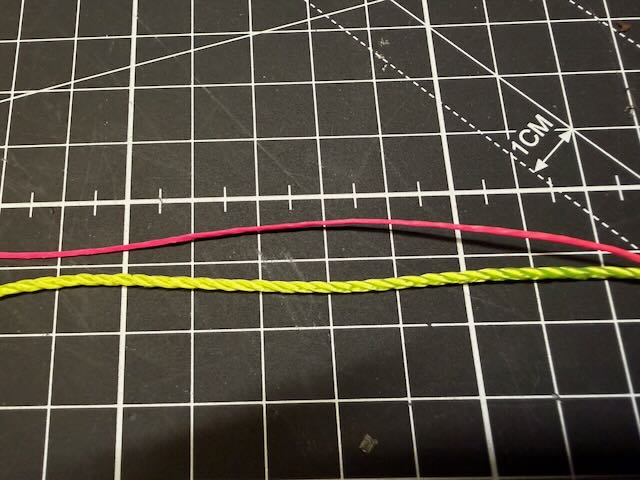
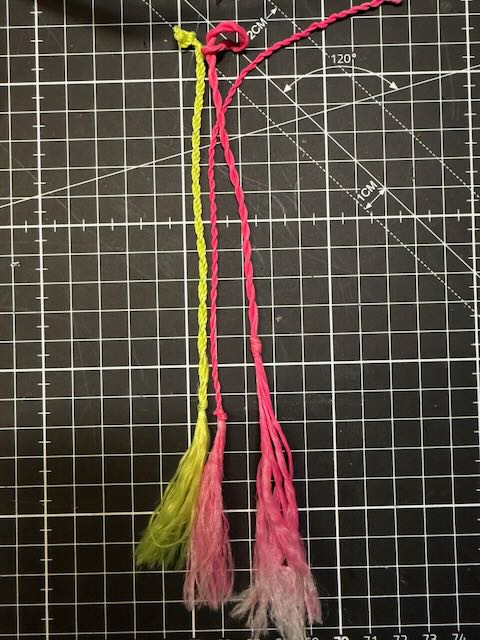
I originally bought this thinking it would be horribly mean, but it fluffs out really nicely, though it takes some work to get there. Compared to Nylon, the fluff is denser while the cracker itself is lighter, and slimmer. Here are 3 crackers after a scene, the two pink crackers are Dacron (4 strand and 8 strand twists), and the neon green is mason line.
UHMWPE SUCKS to cut and will hurt your scissors. I recommend using a box cutter, craft blade, or specific scissors. I ended up with these Wire & Kevlar Cutting Shears from Jonard Tools
For Dacron I use one of two lengths:
- A 90 cm long string, twisted, and folded in half to make a thin 4 strand cracker
- A 180 cm long string folded in half, then twisted, and folded again to make a thicker, 8 strand cracker.
While you can make a 16 strand Dacron cracker by adding another 45cm to the starting length and folding it again, it becomes very large and unwieldy to attach to a whip without use of a jump ring.
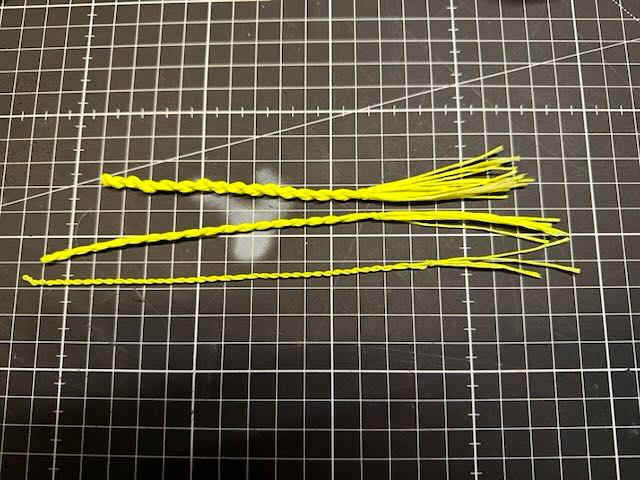
Note: the bow line I’m using has a light coating to it that wears off, many UHMWPE do not and some people use beeswax to help keep strands manageable while making crackers.
Twisting Methods
This video from Viper covers the fundamentals of twisting a cracker:
It’s really that easy, but lets dive into a few other strategies
Leg rolling
Good for masonline
I love this method, it takes a bit to get the hang of it, but if you’re making some quick, fast and loose crackers, it’s really nice and it doesn’t take a ton of thought Rolling your cracker on your leg
Forceps Spinning
Good for everything
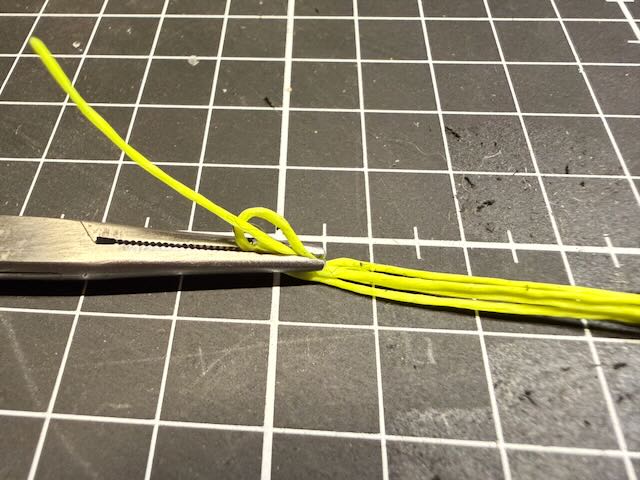
When I started playing with UHMWPE crackers, I played with a few methods including using a battery powered or egg-beater drill. But since I mostly play with small whips, and want small crackers, I found using a pair of forceps works really well. Hat tip to Rusty Bullwhips for the idea, though I find his methods a bit backwards. The following are the steps I take for all crackers, but the photos are for a 4 strand
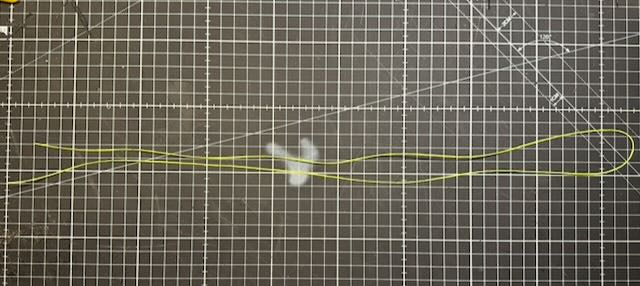
- Folding the strand nearly in half. I leave a slightly longer end (1-2cm), I’ll use this to tie off at the end.
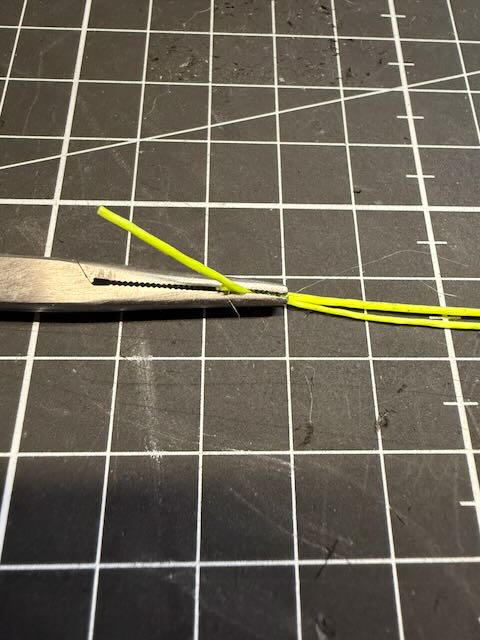
- I grab my loose ends with the forceps
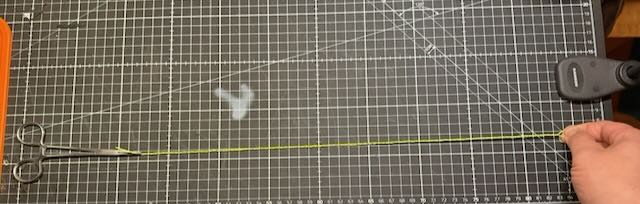
- Holding the loop I let the forceps drop and spin them with my other hand creating a twist.
- Then laying the forceps on the table/couch/my leg so the string won’t untwist
- I grab the middle of the twisted strand, bring the loop ends to the loose ends at the forceps
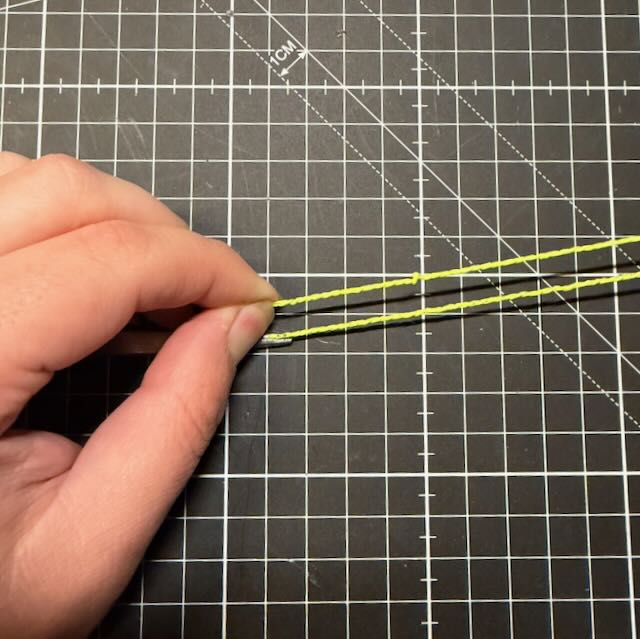
- Then while holding the loop, and the loose ends, I let go of the middle allowing it to twist on itself
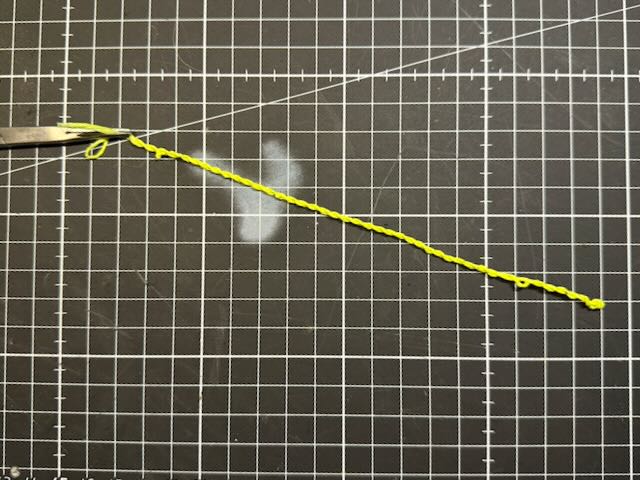
- Untwist the loose ends to the length of fluff I want, isolating the longer strand.
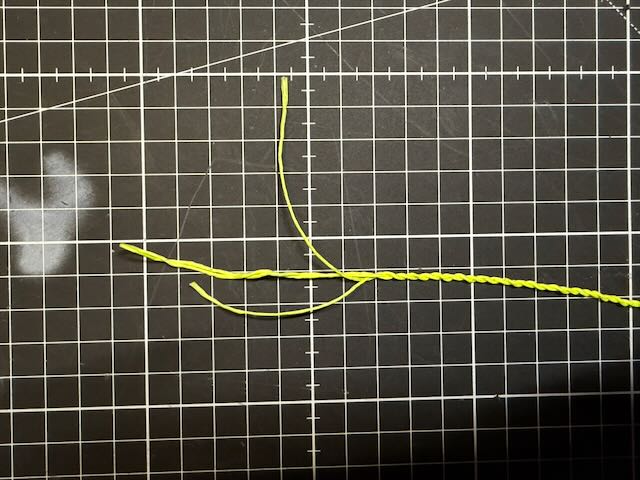
- I use the longer single strand to tie a surgeon’s knot.
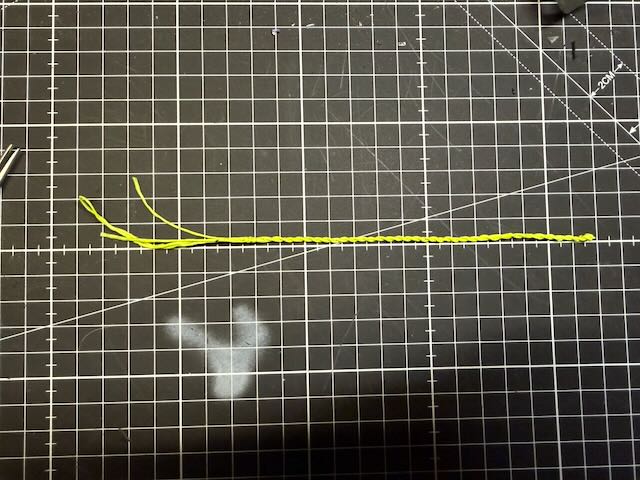
For an 8 strand cracker the strand is longer and folded an extra time before the start
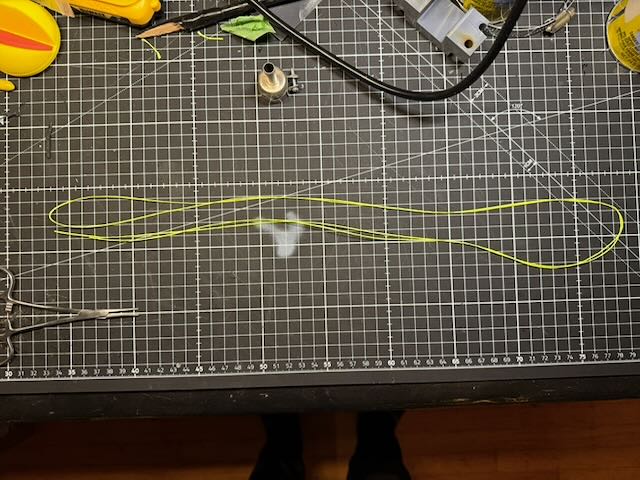 The loose ends now include 2 ends and a loop
Advanced UHMWPE Tapered Crackers
This is extra special, it takes more time, more measuring, but you make a better cracker.
Johnny, from witchcraft whips does a great job of explaining the technique originally shown by Alex from Cobra Whips. Johnny shows us using poly twine, but it’s applicable to other materials.